Movie Review: WRATH OF MAN


Wrath of Man hits theaters tomorrow (Friday, May 7), and let me just say—WOW what a thriller. I was on the edge of my seat the entire movie. If you’re looking for something to do tomorrow, I can’t recommend heading to the theater to see Wrath of Man enough.
What I thought about Wrath of Man
Wrath of Man is a Guy Ritchie film, and if you know his work you know that you’ll start in present day, fast forward a few weeks, go back a few years and sometimes completely lose track of where in time you actually are. Staying true to his roots, that is exactly what Guy Ritchie did with this film. You’re sent forward and backwards to get perspective on how the situation happened for others.
Wrath of Man follows a mysterious new cash truck security guard (Jason Statham) who barely passed his test to become cash truck security guard, but ended up surprising his coworkers during a heist when he unleashed some wicked precision skills. Soon, you learn what his motive is, and that is when you’re hooked. You want to know what’s going to happen, what’s going through his mind and how everything will end.
When I tell you I was on the edge of my seat, I was literally on the edge of my seat. Wrath of Man had no point in the movie that bored me, each scene provided more information into the backstory and things that were going to happen.
As someone who is all about the Hallmark Channel and RomComs, and usually doesn’t get excited for action packed movies I was enthralled with Wrath of Man.
There is A LOT of profanity, the F bomb is dropped a minimum of 20 times. And some pretty gruesome bloody scenes (including faces).
I am an Eastwood fan, and I was excited to see that Scott Eastwood (Clint Eastwood’s son) was in Wrath of Man as well—ladies they introduce him by just showing his eyes—get ready to swoon!
Synopsis of Wrath of Man
A mysterious and wild-eyed new cash truck security guard (Jason Statham) surprises his coworkers during a heist in which he unexpectedly unleashes precision skills. The crew is left wondering who he is and where he came from. Soon, the marksman’s ultimate motive becomes clear as he takes dramatic and irrevocable steps to settle a score.
DIRECTOR: Guy Ritchie
SCREENPLAY BY: Guy Ritchie and Ivan Atkinson & Marn Davies
BASED UPON THE FILM: “Le Convoyeur” Written by Nicolas Boukhrief and Éric Besnard
and Directed by Nicolas Boukhrief
PRODUCERS: Guy Ritchie, Ivan Atkinson, Bill Block
EXECUTIVE PRODUCERS: Louise Killin, Joshua Throne, Steven Chasman, Andrew Golov
CAST: Jason Statham, Holt McCallany, Jeffrey Donovan, Josh Hartnett, Laz Alonzo, Raúl Castillo, DeObia Oparei with Eddie Marsan and Scott Eastwood
RATING: R: Strong Violence Throughout, Pervasive Language, and Some Sexual References
Broadway in Detroit Announces 2021-2022 Season Lineup

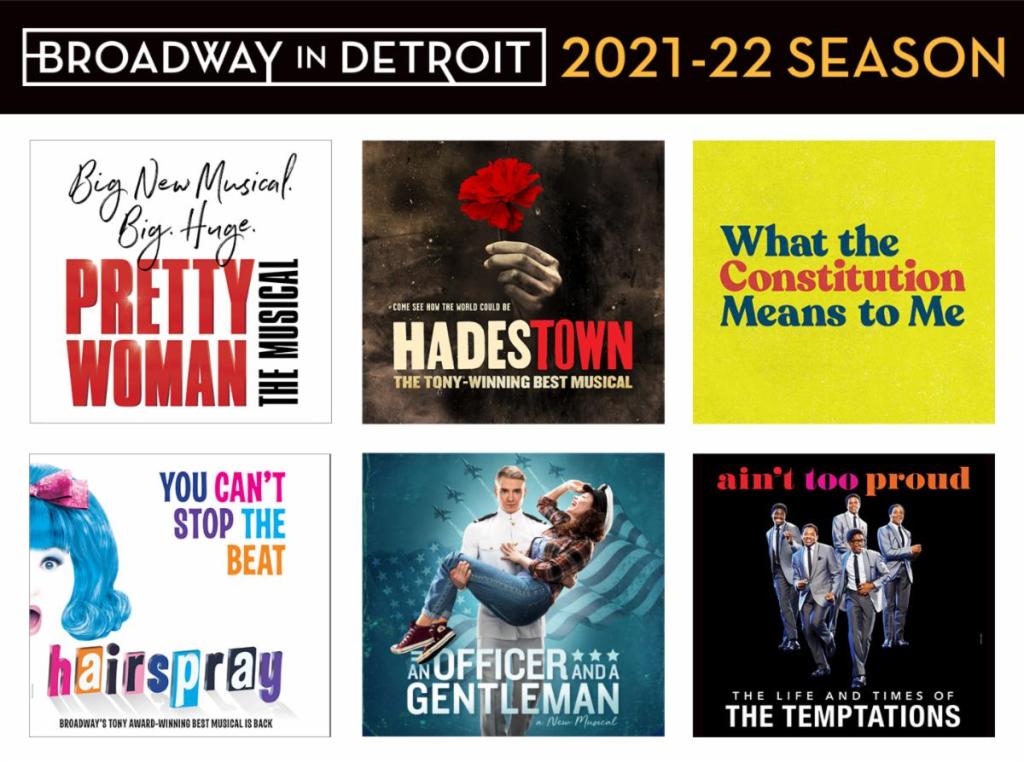
As you know, I am a huge fan of Broadway shows—and it’s been over a year since I saw one. You can imagine my excitement when I saw actual dates for upcoming Broadway In Detroit performances. While two big headliners (Disney’s Frozen and Hamilton) are currently not on the calendar for Detroit visits, Broadway In Detroit did announce that Disney’s The Lion King will return to The Detroit Opera House in early 2022—let me tell you I am SO beyond excited.
Pretty Woman: The Musical
Fisher Theatre | November 2-14, 2021
Hadestown
Fisher Theatre | November 23 – December 5, 2021
What The Constitution Means To Me
Fisher Theatre | December 14, 2021 – January 2, 2022
( no performances December 20-26)
Hairspray
Fisher Theatre | January 18-30, 2022
An Officer and a Gentleman
Fisher Theatre | February 1-13, 2022
Ain’t Too Proud – The Life and Times of The Temptations
Detroit Opera House | August 9-28, 2022
While Disney’s Frozen, which was previously announced as part of Broadway In Detroit’s 2021-22 season, will be scheduled for a future Detroit engagement, Broadway In Detroit is excited to announce that Disney’s The Lion King will return to The Detroit Opera House in early 2022. Performance dates and times will be announced at a future date.
Broadway In Detroit subscriptions for the 2020-21 season have been automatically moved to the 2021-22 Season. Subscribers can review their performance dates and times in their My Broadway In Detroit Ticketmaster account.
“We are very excited to announce dates for the six shows that will make up our 2021-22 season,” states Alan Lichtenstein, Broadway In Detroit Executive Director. “Our subscribers and fans can now look forward to the return to Live Broadway performances at the Fisher Theatre. And when our doors open, we will have a comprehensive health and safety plan in place to ensure that our guests, employees, and visiting productions enjoy the best Broadway experience in Detroit from the front doors of our theatres to the wings of our stages.“
Season Subscriptions are available for new subscribers starting at $319 for all six shows. Broadway In Detroit subscribers receive the same seat (or the equivalent when productions are not at the Fisher Theatre) for all six shows as well as additional VIP privileges including ticket exchanges, priority pre-sales for season extras, discounts and more. Season Subscription information is available online at broadwayindetroit.com/season.
In addition to the 2021-22 Season Subscription performances, Broadway In Detroit has also announced new dates for the previously postponed performances of two shows from the 2019-2020 season.
Beautiful – The Carole King Musical
will now appear at the the Fisher Theatre January 4-9, 2022.Summer: The Donna Summer Musical will now appear at the Fisher March 8-20, 2022. Ticketholders for both of these productions have been notified of the change in performance dates. More information on these rescheduled performances is available at BroadwayinDetroit.com/Covid-19-Updates
Individual tickets and group sales for these productions will go on sale at a future date. Fans and group leaders who would like to be notified when tickets are available are encouraged to join Broadway In Detroit’s email list at the bottom of the broadwayindetroit.com home page.
Pretty Women: The Musical
One of Hollywood’s most beloved stories of all time, Pretty Woman: The Musical is brought to life by a powerhouse creative team representing the best of music, Hollywood, and Broadway. Featuring direction and choreography by two-time Tony Award® winner Jerry Mitchell (Hairspray, Kinky Boots, Legally Blonde), an original score by Grammy® winner Bryan Adams and Jim Vallance (“Summer of ’69”, “Heaven”), and a book by the movie’s legendary director Garry Marshall and screenwriter J.F. Lawton, Pretty Woman: The Musical will lift your spirits and light up your heart. “If you love the movie, you’ll love the musical!” (BuzzFeed News).
Featured in the musical is Roy Orbison and Bill Dee’s international smash hit song “Oh, Pretty Woman,” which inspired one of the most beloved romantic comedy films of all time. Pretty Woman the film was an international smash hit when it was released in 1990. Now, 30 years later, Pretty Woman: The Musical still “Dazzles!” (Deadline) and is “Big romance and big fun!” (Broadway.com). “Irresistible! A romantic fantasy. A contemporary fairy tale,” says The Hollywood Reporter. Pretty Woman: The Musical delivers on all the iconic moments you remember. Get ready to experience this dazzling theatrical take on a love story for the ages.
Hadestown
Winner of eight 2019 Tony Awards® including Best Musical and the 2020 Grammy® Award for Best Musical Theater Album, Hadestown is the acclaimed new show from celebrated singer-songwriter Anaïs Mitchell and innovative director Rachel Chavkin (Natasha, Pierre & The Great Comet of 1812/) It is a love story for today… and always.
Hadestown intertwines two mythic tales — that of young dreamers Orpheus and Eurydice, and that of King Hades and his wife Persephone — as it invites you on a hell-raising journey to the underworld and back. Mitchell’s beguiling melodies and Chavkin’s poetic imagination pit industry against nature, doubt against faith, and fear against love. Performed by a vibrant ensemble of actors, dancers and singers, Hadestown is a haunting and hopeful theatrical experience that grabs you and never lets go.
What the Constitution Means to Me
Direct from Broadway, the 2019 Tony® nominated Best Play and Pulitzer Prize finalist, What the Constitution Means to Me, by famed writer Heidi Schreck, arrives in Detroit for a strictly limited engagement.
Playwright Heidi Schreck’s boundary-breaking play breathes new life into our Constitution and imagines how it will shape the next generation of Americans.
Fifteen year old Heidi earned her college tuition by winning Constitutional debate competitions across the United States. In this hilarious, hopeful, and achingly human new play, she resurrects her teenage self in order to trace the profound relationship between four generations of women and the founding document that shaped their lives.
Schreck’s timely and galvanizing play, directed by Oliver Butler, became a sensation off-Broadway last fall before transferring to Broadway where it received two Tony Award® nominations among countless other accolades. See the play The New York Times hails as “not just the best play on Broadway, but also the most important.”
Hairspray
Hairspray, Broadway’s Tony Award-winning musical comedy phenomenon that inspired the blockbuster film and live television event, is back on tour! Join 16-year-old Tracy Turnblad in 1960’s Baltimore as she sets out to dance her way onto TV’s most popular show. Can a girl with big dreams (and even bigger hair) change the world?
Featuring the beloved score of hit songs including “Welcome to the 60’s,” “Good Morning Baltimore,” “It Takes Two,” and incorporating “Ladies Choice” from the musical film adaption, Hairspray is “fresh, winning, and deliriously tuneful!” (The New York Times).
This all-new touring production will reunite Broadway’s award-winning creative team led by Director Jack O’Brien and Choreographer Jerry Mitchell to bring Hairspray to a new generation of theater audiences. Don’t miss this “exhilaratingly funny and warm-hearted musical comedy” (The New Yorker).
An Officer and a Gentlemen
An Officer and a Gentleman, based on the Oscar-winning film starring Richard Gere, is a breathtaking production that celebrates triumph over adversity and includes one of the most iconic and romantic endings ever portrayed on screen. Featuring the Grammy Award winning, #1 hit single ‘Up Where We Belong’, and a score based on the 1980’s catalogue of music that gave voice to a generation, the live stage production is a new adaptation by multiple Tony Awards nominee Dick Scanlan (Thoroughly Modern Millie, Everyday Rapture), based on the original screenplay by Douglas Day Stewart. The musical is directed by Scanlan with choreography by Patricia Wilcox (Motown, A Night with Janis Joplin).
Zack Mayo’s got smarts and a body built for US Navy pilot boot camp, but he also has too much swagger… until he meets a drill sergeant who’s determined to drill his arrogance out of him. Zack finds comfort in the arms of a local factory girl. But it isn’t until tragedy befalls a fellow candidate that Zack learns the importance of love and friendship, and finds the courage to be his best self and win the heart of the woman he loves. A sweeping romance that lifts you up where you belong.
Ain’t Too Proud
Ain’t Too Proud is the electrifying, new smash-hit Broadway musical that follows The Temptations’ extraordinary journey from the streets of Detroit to the Rock & Roll Hall of Fame. With their signature dance moves and silky-smooth harmonies, they rose to the top of the charts creating an amazing 42 Top Ten Hits with 14 reaching number one.
Nominated for 12 Tony Awards, Ain’t Too Proud tells the thrilling story of brotherhood, family, loyalty, and betrayal, as the group’s personal and political conflicts threatened to tear them apart during a decade of civil unrest in America.
The unforgettable story of this legendary quintet is set to the beat of the group’s treasured hits, including “My Girl,” “Just My Imagination,” “Get Ready,” “Papa Was a Rolling Stone” and so many more.
Written by three-time Obie Award winner Dominique Morisseau, directed by two-time Tony Award winner Des McAnuff (Jersey Boys) and featuring the Tony-winning choreography of Sergio Trujillo (Jersey Boys, On Your Feet!), Ain’t Too Proud launches their first national tour to over 50 cities across America.
Beautiful
From the string of pop classics Carole King wrote for the biggest acts in music, to her own life-changing, chart-busting success with Tapestry, BEAUTIFUL takes you back to where it all began—and takes you on the ride of a lifetime.
Featuring over two dozen pop classics, including “You’ve Got a Friend,” “One Fine Day,” “Up on the Roof,” “You’ve Lost That Lovin’ Feeling,” “Will You Love Me Tomorrow,” and “Natural Woman,” this crowd-pleasing international phenomenon is filled with the songs you remember—and the story you’ll never forget.
Summer: The Donna Summer Musical
She was a girl from Boston with a voice from heaven, who shot through the stars from gospel choir to dance floor diva. But what the world didn’t know was how Donna Summer risked it all to break through barriers, becoming the icon of an era and the inspiration for every music diva who followed. With a score featuring more than 20 of Summer’s classic hits including “Love to Love You Baby,” “Bad Girls” and “Hot Stuff,” Summer: The Donna Summer Musical is an electric experience and a moving tribute to the voice of a generation.
For more information on Broadway In Detroit, subscriptions, group sales and more, please visit www.BroadwayInDetroit.com
Data Catalog Basics


Technology is ever changing, and that means tools are constantly being improved. From decisions and improvements to campaigns if you’re a successful company changes are you are a data driven company. Data provides the details to make the hard decisions you might not be able to make otherwise. That being said, there is so much data out there it makes it hard to keep up with the important information you need.
If you have a large company with substantial inventory, who are you relying on to organize all that data? Do you use a system or do you use a person. If you answered a person, is that really the best way to utilize company time and money? The person employee could instead be utilizing a data catalog tool and providing you with important data that is at their fingertips instead of having them manually mine for data. Think about it, if you have the data right in front of you then you can make faster decisions.
What is a data catalog tool?
A data catalog is a metadata management tool that companies use to inventory and organize data within their systems. Typical benefits include improvements to data discovery, governance, and access.
Gartner describes the data catalog: “data catalog tools maintain an inventory of data assets through the discovery, description, and organization of datasets.
Why is data catalog important?
Data is the foremost competitive battleground of our time. The threat to every business is existential. Therefore, today’s winners prioritize giving employees accurate, clear, and fast answers to every business question.
What is a data catalog?
Data catalogs improve data clarity, accuracy, and speed. Data catalogs definitely will make you a more data driven company.
1. Clarity. Everything needed to understand data is kept and maintained from the beginning. As people use the data catalog, things will become clearer.
2. Accuracy. A wider array of people can validate, improve, and correct data and analysis.
3. Speed. People can find what they need faster by organizing data and analysis in discoverable, business-friendly ways with all the content easily accessible.
Key factors of a successful data catalog
Just like anything else, not all data catalogs are created equal. When you’re selecting a data catalog you want to to find ones that offer you the capabilities that you need. Below are some popular key capabilities you should look for when considering data catalog tools:
1. Connectors. Having a wide variety of connectors allows the data catalog to map physical datasets. With capabilities like this you can harvest metadata from business intelligence tools like Salesforce and SAP.
2. Automation. Talk about a time saver. With enhanced automation you don’t have to mine for your data manually.
3. Search. Search is not one size fits all, therefore you want something that you can specify different parameters so you can easily find/discover the data you are interested in.
4. Lineage. You want lineage to perform root cause analysis which will help link dashboards for easy access to data.
5. Profiling. When you connect different data sources, data profiling because essential. Data profiling allows you to assess your data quality for completeness, accuracy and consistency.
Best flooring for educational spaces


Have you been given the task of choosing material for a K-12, university, or other learning environment and have no clue where to begin? Look no further, I’m spilling the basics to help you pick the best flooring for your educational space.
Flooring is what leads you in and out of the building, and transitions you from one space to another. It expands from each room individually and into common areas. Flooring in educational spaces is part of heavily-trafficked areas, and that’s why you want to make sure you’re getting quality flooring that is going to last. No one wants to throw away money on something that is only going to last a few years.
Best classroom flooring
When it comes to classroom flooring the aesthetic matters more than most people think about. You want the students to focus without being distracted, and comfortable without losing focus. Can’t forget about them being safe and skip resistant. Oh yeah, and they need to take a beating from chairs pushed, shoes, desk rearranged, and more.
Carpet tiles in a school setting should be low profile, which helps make them more durable under heavy foot traffic, plus they are slip-resistant. They come in a wide variety of color and pattern options, which can be good and bad when you’re trying to come to one choice. Carpet tiles are great for grade school classrooms or specific subjects such as math or history. Carpet tiles are NOT great for a science lab or art classes where things can spill.
Vinyl tile comes in two forms vinyl composition tile (VCT) and luxury vinyl tile (LVT). VCT has been used in schools for decades. However, this porous material is a little bit high maintenance as it requires to be waxed and polished regularly. On the plus, it’s durable under high traffic and inexpensive. Luxury vinyl tile or LVT tile is the preferred option in educational spaces nowadays. Unlike VCT that is made of vinyl, limestone, and other ingredients LVT is 100% vinyl and less porous. LVT is designed to last longer and hold up better when it comes to foot traffic than VCT will—plus it doesn’t require constant wax applications. LVT will run you more than VCT, but it’ll be less maintenance in the long run—which really is what you’re going after anyway.
Laminate used to be the most popular option, but it seems like its days of being the go-to has come and gone. Other flooring options like LVT have caught up and surpassed this option, but it’s still worth mentioning. Laminate is resistant to fading, scratching, and other kinds of damage.
Best hallway flooring
The hallway gets a lot of traffic, you want something that will be resilient and give you your most bang for your buck. This means you’re going to want to look at VCT or LVT. Remember though, VCT is going to require maintenance while LVT will cost you a little more, it will not require the maintenance that VCT does. Rubber flooring has also become popular due to its variety. Mainly because you can customize it with any pattern, logo, or color.
31 Things To Do in May


From gardening and farmers markets to road trips and more i’m sharing 31 ways you can get the most out of May.
- Happy May Day! This fun springtime tradition is all about making a colorful handmade May Day basket, filled with candy or flowers and then you leave it on your neighbor’s porch. I absolutely love this sweet tradition.
- May is National Bike Month. Spend time on the trails, rent a bike from a metropark or head to the city and rent a bike and start exploring.
- We could all use a moment of zen, and in hour of Garden Meditation Day, take time to slow down and absorb your surroundings.
- May the Fourth Be With You! Happy Star Wars Day. Celebrate by watching your favorite Star Wars movie.
- Welcome Cinco de Mayo with a tacos and nachos served up charcuterie style.
- Setup your outdoor space. Are you stocked up on wood for bonfires? Are you chairs and table cleaned for outdoor dining?
- Happy National Tourism Day! Today is the perfect day to make a list of the places you’d like to visit.
- Add a new wreath to your front door. Pinterest is filled with plenty of ideas if you want to DIY your own.
- Happy Mother’s Day to all the mama’s out there—I see you dog mama’s. From brunch, to treks in the woods, however you celebrate I hope you have a fabulous day.
- Trees and gardens are bursting with blooms. Get outside and take a walk around time and enjoy all the beauty spring has to offer.
- Head out for a hike. You know this is my favorite. Not only do I love discovering new (to me) trails, but I also love my tried and true ones.
- Buy yourself a bouquet of flowers to brighten your day. Peonies are starting to pop up in stores.
- The weather is getting nicer, and we’re all spending time outdoors—are you stocked up on sunscreen and bug spray?
- Grilling season is finally here. Whether you’re cooking veggie kabobs and pineapple or more traditional burgers and brats put your grill to work while the weather is nice.
- Head to the zoo. If you haven’t heard the Detroit Zoo has a baby polar bear that is the cutest thing ever and definitely worth the trip.
- It’s World Baking Day today. Celebrate by whipping up something new. I’ll be making some lemon bars.
- Make a pizza on the grill.
- Farmers market season is in full swing. From fresh baked breads and desserts to early produce and fresh cut blooms you’re sure to find something.
- Visit a local metropark and venture to a state park.
- Plan a camping trip. You can tent camp or look on Airbnb or Outdoorsy for campers you can rent.
- Hit the open road with the windows down on search of a new town. Road trips are my favorite during the summer and the possibilities are endless.
- Rent a scooter and see the city from a different perspective.
- Visit a greenhouse and start picking out flowers, herbs and produce you want to plant in your yard this year.
- Bocce ball, horseshoes and bags, oh my! Break out the yard games.
- Have a picnic.
- Go horseback riding.
- Find food trucks to eat at.
- Grab some popcorn and snacks and get ready because Cruella is released in theaters and Disney+ Premier today.
- Make homemade lemonade
- It’s the perfect night to have a bonfire and enjoy popcorn and s’mores over it.
- Happy Memorial Day. Rock that red, white and blue—BBQ and play some backyard games. The unofficial start of summer has begun.

